

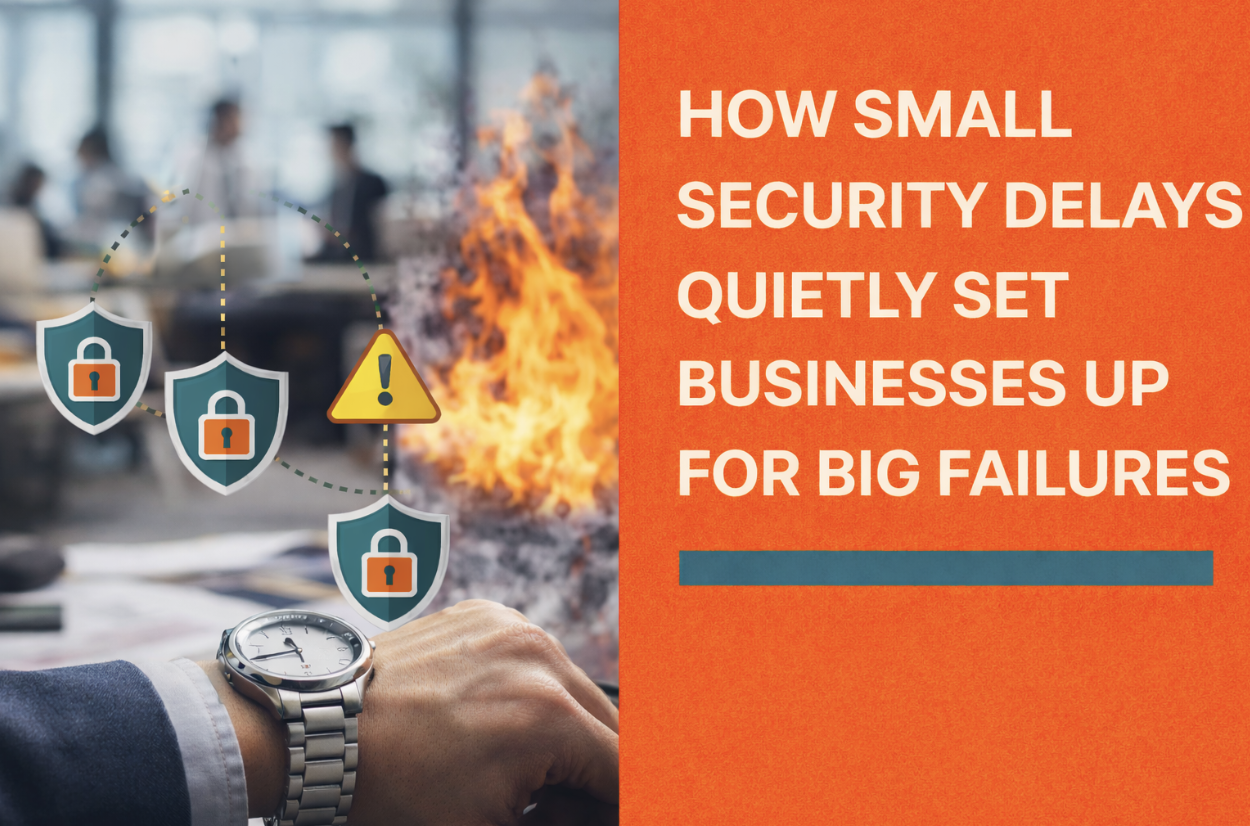
Big cybersecurity failures rarely start with big mistakes. They usually begin with small and often postponed decisions ; ones that make total sense in the moment.
A patch gets delayed. A tool upgrade is postponed. A risk is acknowledged but not acted on yet.
Nothing breaks. Nothing feels urgent. Business continues as usual. And that’s exactly the problem.
Picture a normal week at a growing business. The IT team flags a vulnerability that needs fixing. Leadership agrees it’s important. But there’s a product launch coming up. Or a tight budget cycle. Or a vendor contract still under review. So the decision is simple: we’ll handle it next month. Next month comes and something else takes priority. From the outside, everything still looks fine. Systems are running. Customers are happy. No alarms are going off.
This is how security risk quietly settles in.
One of the most dangerous side effects of security delays is false reassurance.
Nothing bad happens after the first delay. Or the second. Or the third.
So the organization subconsciously learns:
“We've waited before, and it turned out fine.”
That mindset slowly normalizes risk. What once felt urgent now feels optional. Over time, unresolved issues stop standing out and unfortunately blend into the background.
This isn't recklessness. It's human nature.
While decisions are delayed, the environment around them keeps changing.
Meanwhile, attackers don’t pause. They actively look for known weaknesses that organizations haven't gotten around to fixing yet.
What started as a small, contained issue quietly grows into something much harder and more expensive to fix.
When things finally go wrong, it often doesn't look like a movie-style cyberattack.
Instead, it’s something subtle:
A system behaving strangely
A few users locked out
Data accessed when it shouldn’t have been
By the time the seriousness becomes clear, the damage is already done and the timeline matters.
Security investigations almost always uncover the same pattern:
“This issue was known… but deprioritized.”
When small security delays turn into big failures, the impact spreads fast. This results in:
What makes it worse is the realization that the failure wasn’t sudden or unpredictable. It was built slowly, decision by decision.
That’s a hard lesson for any organization.
Most businesses don’t delay security because they don’t care. They delay because:
Security work is preventative. When it’s done right, nothing happens and that makes it easy to undervalue.
The goal isn't to fix everything at once. It's to stop the quiet buildup.
A few mindset shifts help:
Momentum matters more than massive change.
Big cybersecurity failures don't usually come from one bad decision. They come from many small ones that felt harmless at the time. The businesses that avoid them aren't the ones with perfect security; they're the ones that take small risks seriously before they grow into big problems. Sometimes, the most important security decision is simply choosing not to wait.
Talk to our team of experts to learn more.


