
First-time certification projects often focus heavily on documentation while overlooking the people who'll actually be interviewed during the audit.
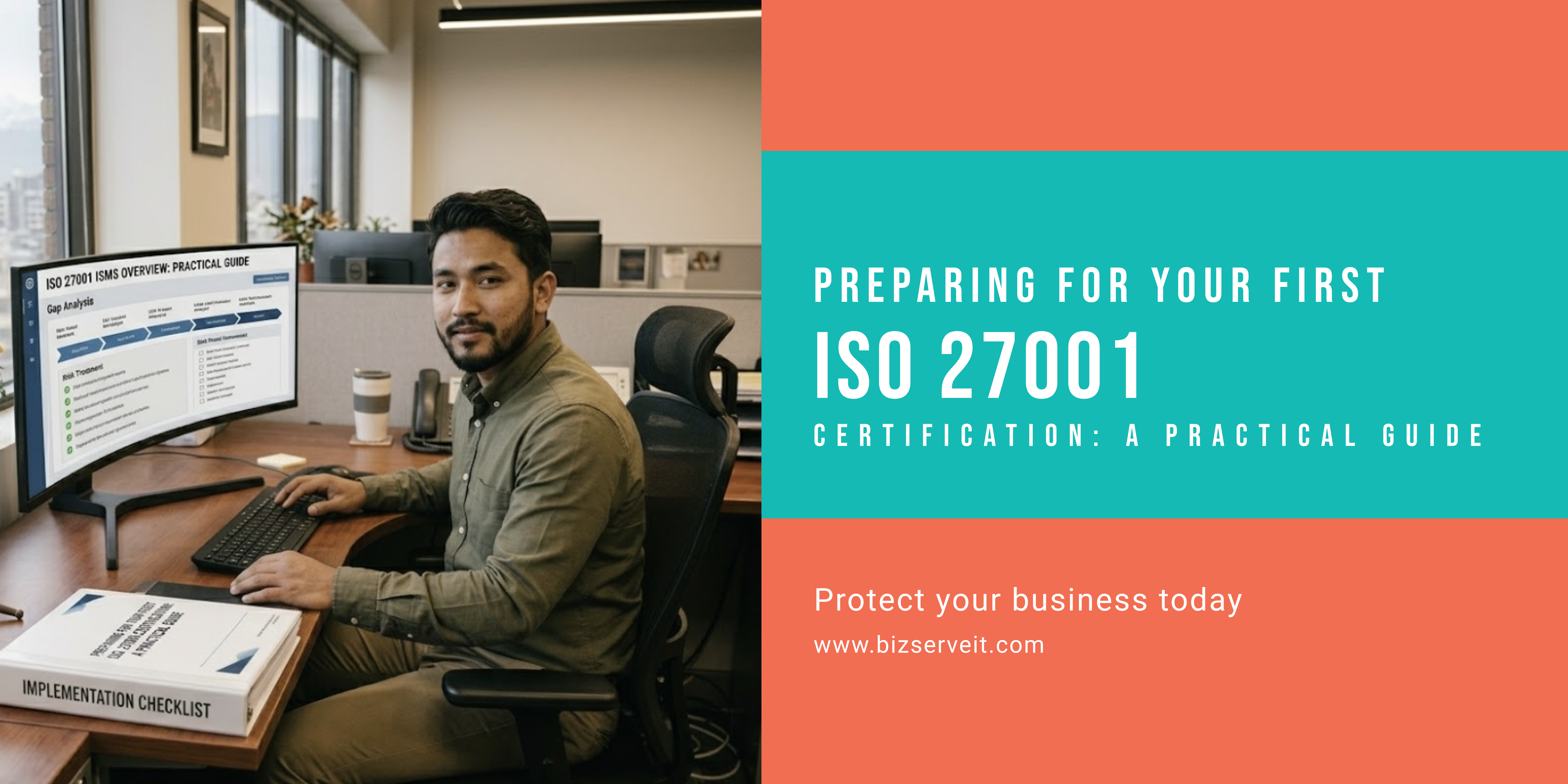
A practical guide to getting audit-ready without the last-minute scramble.
Achieving ISO 27001 certification is a major milestone in any organization's security journey — but for most teams attempting it for the first time, the road there can feel overwhelming. Policies to write, risks to assess, controls to implement, evidence to gather, audits to prepare for, all while balancing tight timelines and client expectations. It's no surprise that first-time applicants approach certification with a mix of excitement and nerves.
At Biz Serve IT, we've guided organizations across Nepal, the Maldives, Sri Lanka, the UAE, Kuwait, and the UK through this process — from banks and fintechs managing complex regulatory obligations to growing businesses pursuing certification for the first time. One thing holds true across all of them: certification is not about building a flawless security setup overnight. Auditors aren't looking for perfect organizations. They're looking for proof that you understand your information security risks, have the right controls in place, and are committed to continuous improvement.
This guide walks through how to prepare for your first ISO 27001 certification, the mistakes to avoid, and how to build genuine confidence before audit day.
Before diving into preparation, it helps to be clear on what ISO 27001 actually certifies.
ISO 27001 is an international standard for building, managing, and continuously improving an Information Security Management System (ISMS). Rather than focusing purely on technical safeguards, it evaluates how your organization identifies, manages, and reduces information security risk across people, processes, and technology.
This distinction matters because many organizations assume certification is mainly about producing documents. In reality, it's about showing that information security is woven into everyday operations. A policy that exists on paper but isn't followed proves nothing. A process that's consistently used, reviewed, and improved is what auditors are actually looking for.
One of the most common first-time mistakes is trying to cover everything at once. Before implementing controls or drafting policies, define your ISMS scope clearly. This includes:
A well-defined scope gives auditors clarity on the boundaries of your ISMS, and just as importantly, it keeps your first certification effort from becoming unnecessarily complex. Scope is the foundation — get it wrong, and everything built on top becomes harder to manage.
A common trap is treating ISO 27001 as a documentation exercise: writing policies and procedures before understanding the risks they're meant to address. A strong certification journey starts with risk assessment, identifying:
This process determines which controls are actually necessary, and gives leadership the context to make informed risk decisions rather than implementing controls purely for compliance's sake. When auditors review your ISMS, they're looking for a clear, traceable link between identified risks and the controls addressing them. Without that link, even meticulous documentation can look hollow.
Policies alone won't get you certified — auditors need to see your controls working in practice. Useful evidence includes:
The stronger and more consistent this evidence trail, the smoother your audit will go.
First-time certification projects often focus heavily on documentation while overlooking the people who'll actually be interviewed during the audit. Auditors talk to employees to confirm that security practices are genuinely part of daily operations — not to test whether staff can recite ISO clauses, but to see whether they understand their role in protecting information.
Employees should be comfortable discussing:
The goal isn't scripted answers — overly rehearsed responses often come across as less credible than honest, practical explanations. Organizations that invest in role-specific awareness training tend to perform noticeably better during audits, simply because employees can speak confidently about how security fits into their day-to-day work.
A thorough internal audit before your certification assessment is one of the highest-value steps you can take. Think of it as a dress rehearsal rather than a pass/fail test. It helps you:
Organizations that skip this step often discover, during the real audit, issues that could have been resolved weeks earlier.
Even when controls are working well, poor evidence organization can cause delays and confusion. Before your assessment:
Auditors follow logical evidence trails — when documents are easy to find and clearly tied to their related processes, audits move faster with fewer interruptions.
For first-timers, uncertainty is often the biggest source of stress. In practice, certification audits are structured and predictable. Auditors will typically:
The goal isn't to catch you out — it's to confirm the ISMS operates effectively and consistently. Organizations that approach auditors with honesty and transparency tend to have a far more positive experience than those trying to mask weaknesses. Treating auditors as people — professional but approachable — also goes a long way; it's perfectly fine to ask about their focus areas for the day.
During the audit, keep regular operations running, keep the team informed with a clear schedule, document any changes, and take notes on discussions so follow-up items don't get lost.
Controls take time to generate records. Starting two weeks before the audit won't produce enough history to demonstrate effectiveness.
A bloated ISMS is harder to manage and maintain. Simple, clear documentation almost always serves better than excessive paperwork.
Information security is an organization-wide responsibility. Without leadership involvement, certification efforts tend to lose momentum and support.
Auditors expect imperfections. What matters is your ability to find issues, fix them, and demonstrate improvement over time.
Many organizations treat certification as the end goal. In reality, it marks the start of an ongoing improvement cycle. Afterward, organizations need to continue:
The organizations that get the most value from ISO 27001 use it not just as a compliance milestone, but as an ongoing framework for better security decision-making.
Success in your first ISO 27001 certification doesn't come from last-minute scrambling or over-engineered documentation. It comes from building an ISMS that genuinely reflects how your organization manages information security: define your scope, build around risk, gather real evidence, prepare your people, and test your readiness through internal audits.
On audit day, the organizations that perform best aren't the ones with the thickest policy binders — they're the ones who can clearly demonstrate that security is understood, practiced, and continuously improved across the business.
The organizations that get certified — and stay certified — are the ones that build this in from day one.
Need help preparing for your first ISO 27001 certification?
Biz Serve IT works with organizations across banking, fintech, and other regulated sectors to build ISMS frameworks that hold up under audit — from scoping and risk assessment through internal audits and audit-day support.


